
As an Amazon Associate I earn from qualifying purchases. Every product below is gear we bought with our own money and use at DodgeArrows Annapolis. Nobody paid for a mention.

A glow party is an ordinary party with the lights off and ultraviolet lamps on, so certain colors appear to light up from the inside. We run these most weekends, and the question parents ask every single time is some version of could I do this at home?
Yes, and for less than you think. The lighting is the cheap part. What costs money is buying the wrong lights first, which is what this guide exists to prevent.
If you just want the shopping list without the explanation, we keep every item on one page: the glow gear we actually use.
Why things glow
A blacklight puts out ultraviolet light, which your eyes cannot see. Certain materials absorb that invisible light and spit it back out in a color you can see. That is the whole trick. The object is not lit up the way a flashlight lights a wall. The object is doing the glowing itself.
The practical version: the lamp stays dark, and only the right stuff lights up. That contrast is the entire effect, and it is why one wrong white light in the corner ruins a room.
What glows hard: neon and fluorescent colors, especially yellow, orange, pink and green. Plain white fabric, because laundry detergent leaves brighteners in it. White paper, highlighters, petroleum jelly, tonic water.
What does not glow, no matter what you pay: black, navy, dark red, most browns. Most natural wood and bare concrete. Skin, unless you put something on it.
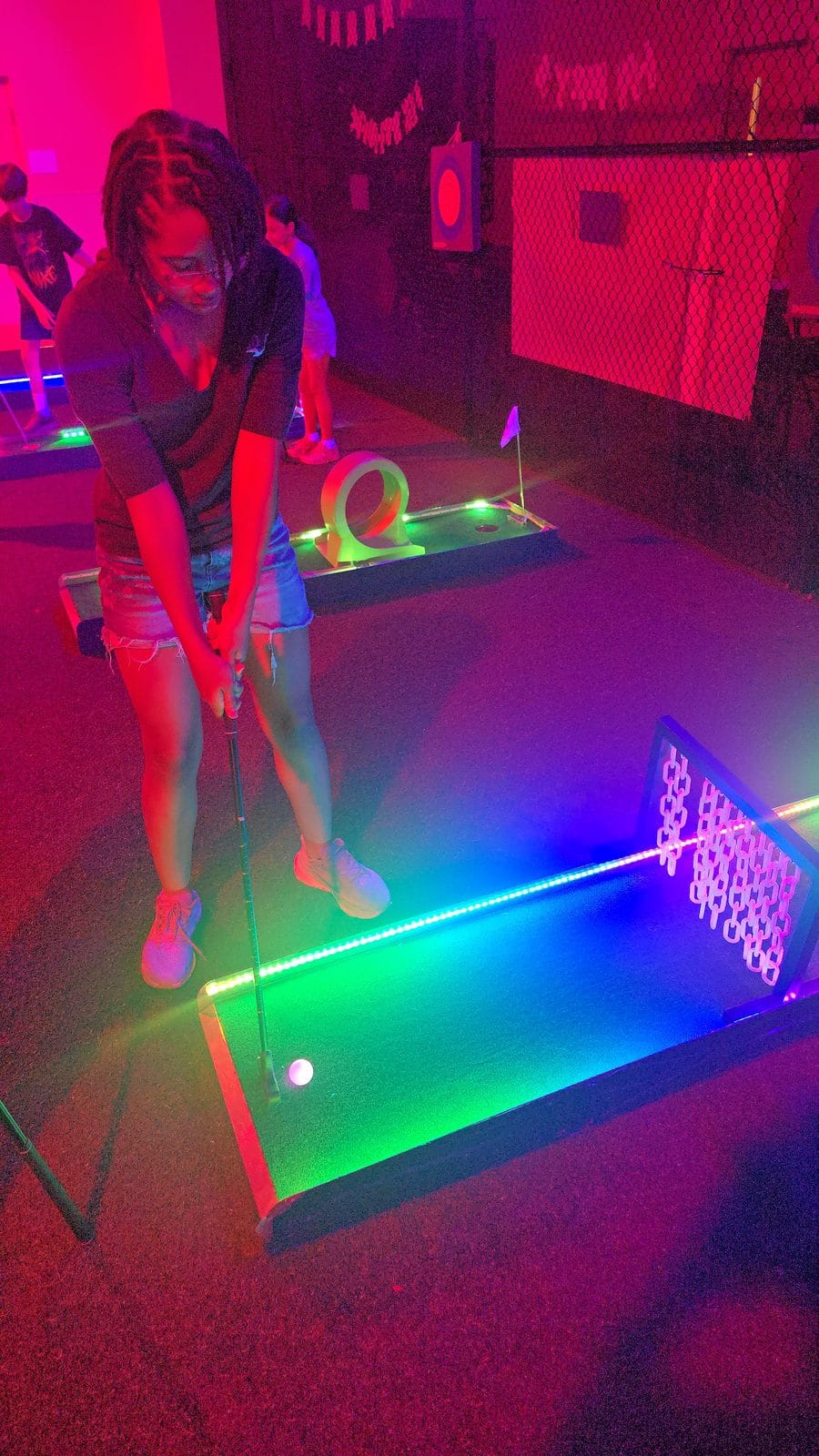
One number matters when you shop. Look for 395nm. That is the wavelength that makes things glow brightest while still looking dim to the eye. Lamps labeled 365nm glow more purely with less visible purple haze, but they cost more and run dimmer. For a party, 395nm is the right call.
The lights, in the order you should buy them
Each one does a different job, and skipping to the fancy stuff first is the most common way people waste money.
- Rechargeable UV lantern — fills a room with even UV, no outlet needed. Covers roughly a 15 by 15 ft room. If you buy exactly one thing, buy this. No cord across a floor full of kids, and it doubles as a camping light the other 51 weekends of the year.
- UV LED strip, 100 ft — outlines walls, doorways, tables and stair edges. This is what makes a garage read as a venue, because it gives the eye an edge to find.
- 600W UV floods, 2 pack — blasts a wall or play area from a distance. For a hall or a big yard, cheaper than buying six lanterns.
- Moving head DJ lights — movement and color on the ceiling. Buy after the UV is sorted, not before.
- Laser light show projector — thousands of moving dots. Pure spectacle, and worth it last.
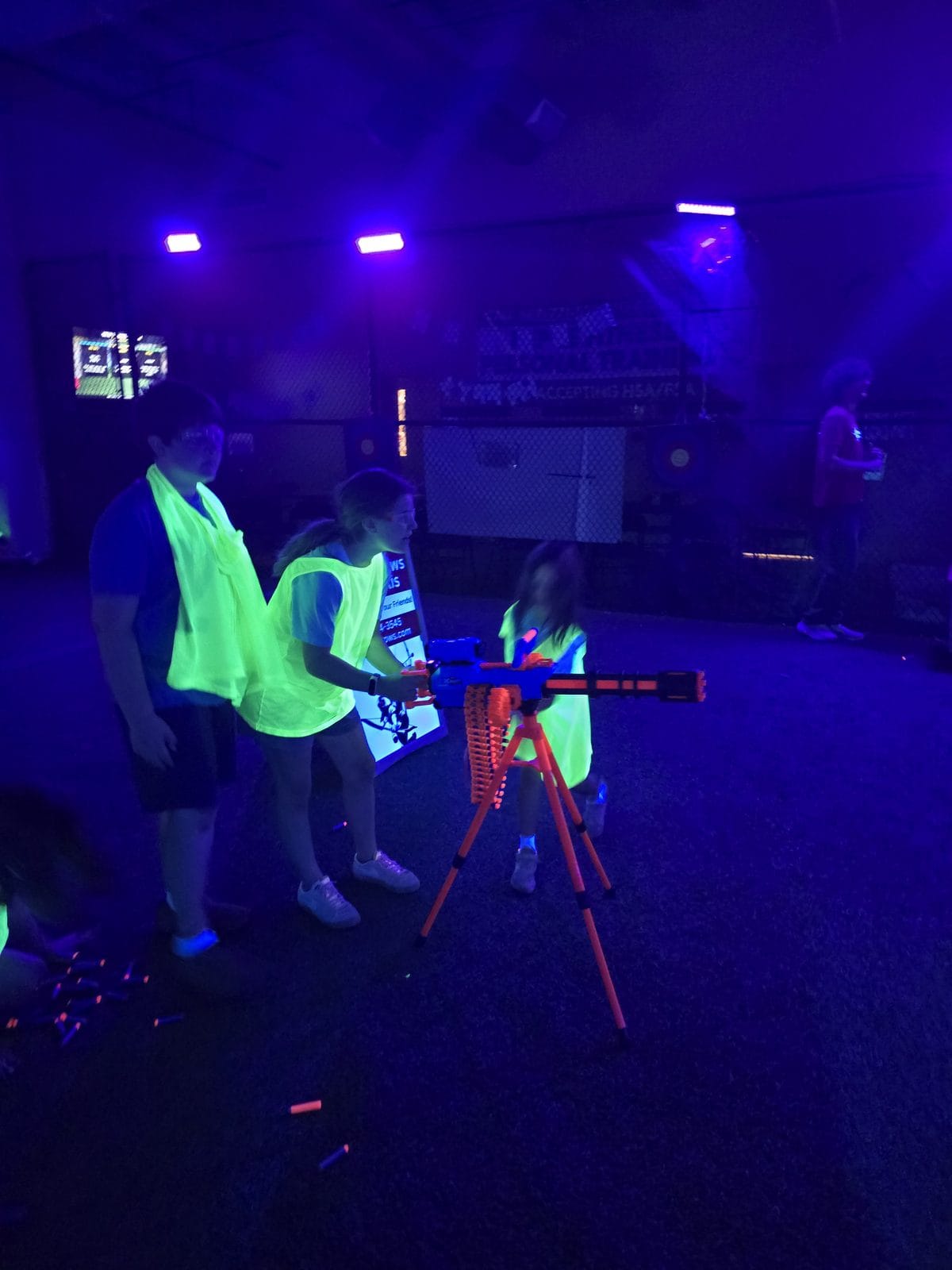
How many lights do I need? A rough rule from running these: one good UV source per 200 square feet, aimed across the room rather than down at the floor. A standard two-car garage takes two. A church hall takes six or more, which is the point where flood lamps become cheaper than lanterns.
What to actually make glow
This is where a glow party is won. The lights are the stage. These are the actors.
Start with tape. Neon gaffer tape in six colors is the single highest-return item on this page. It peels off clean, it does not shine under normal light, and under UV it turns a plain floor into a court. We tape boundary lines, foul lines, and arrows to the bathroom. Gaffer tape, not duct tape, because duct tape leaves adhesive on a gym floor and you will hear about it.
Fluorescent spray paint is for anything you want to permanently convert: a plywood target, cornhole boards, an old set of cones. Two light coats over a white primer, because the paint glows far better over white than over bare wood.
Then the balls, which is what people remember:
- Luminous Rhino Skin dodgeballs — glow trails as they fly. The reason we bought them.
- Glow in the dark basketball — holds a charge from the UV, visible mid-air.
- Luminous basketball net — marks the hoop so nobody shoots blind.
- LED light-up golf balls — battery lit, not UV, so they work in a pitch black yard with no other gear.
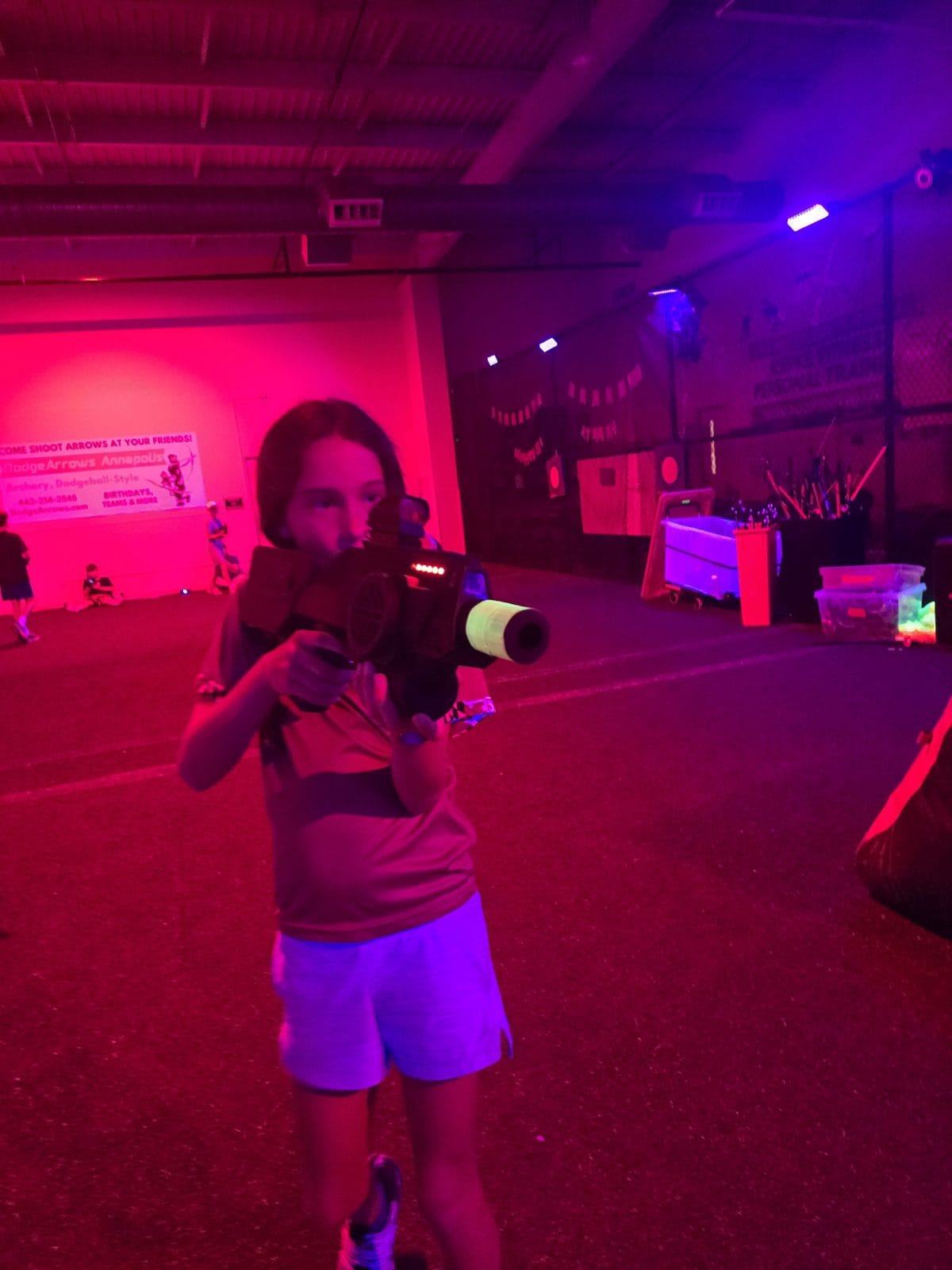
Worth knowing: the dodgeballs and basketball are phosphorescent, meaning they soak up light and release it slowly. Park them under the UV for ten minutes before guests arrive and they start the night at full brightness.
Sound matters more than one more light
A dark room with no sound feels like a power outage. Sound is what turns it into a party.
The JBL PartyBox 310 is the workhorse. Battery powered, loud enough for a full hall, and it has wheels, which sounds trivial until you have carried a speaker across a parking lot at 9pm.
A pair of wireless microphones does more work than people expect. Somebody has to explain the rules, call teams and run the countdown. Shouting over music for two hours wrecks your voice. Two mics also let a kid announce their own birthday, which lands every time.
Bubbles are the cheapest atmosphere money buys. Under UV they catch the light and drift. An automatic bubble machine in a corner fills the room, and handheld bubble guns keep younger kids busy during gaps. Buy solution by the gallon, never the little bottles. A machine drinks it.
One caution. Bubble solution on a hard floor is genuinely slippery. Run the machine over grass, over carpet, or off to the side where nobody is running.
Games that work in the dark, and the ones that do not
The test is simple: can a player track the thing they need to track?
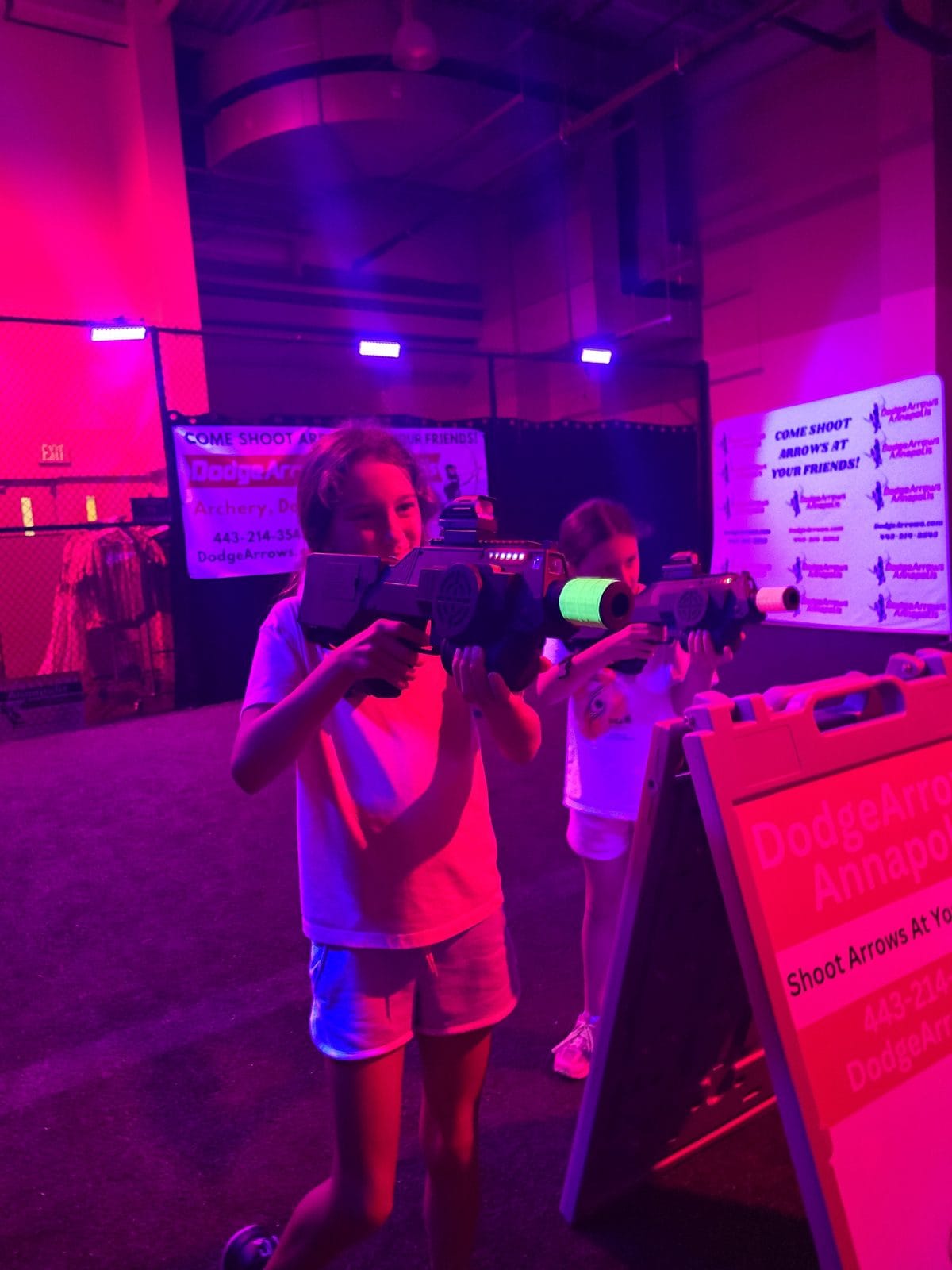
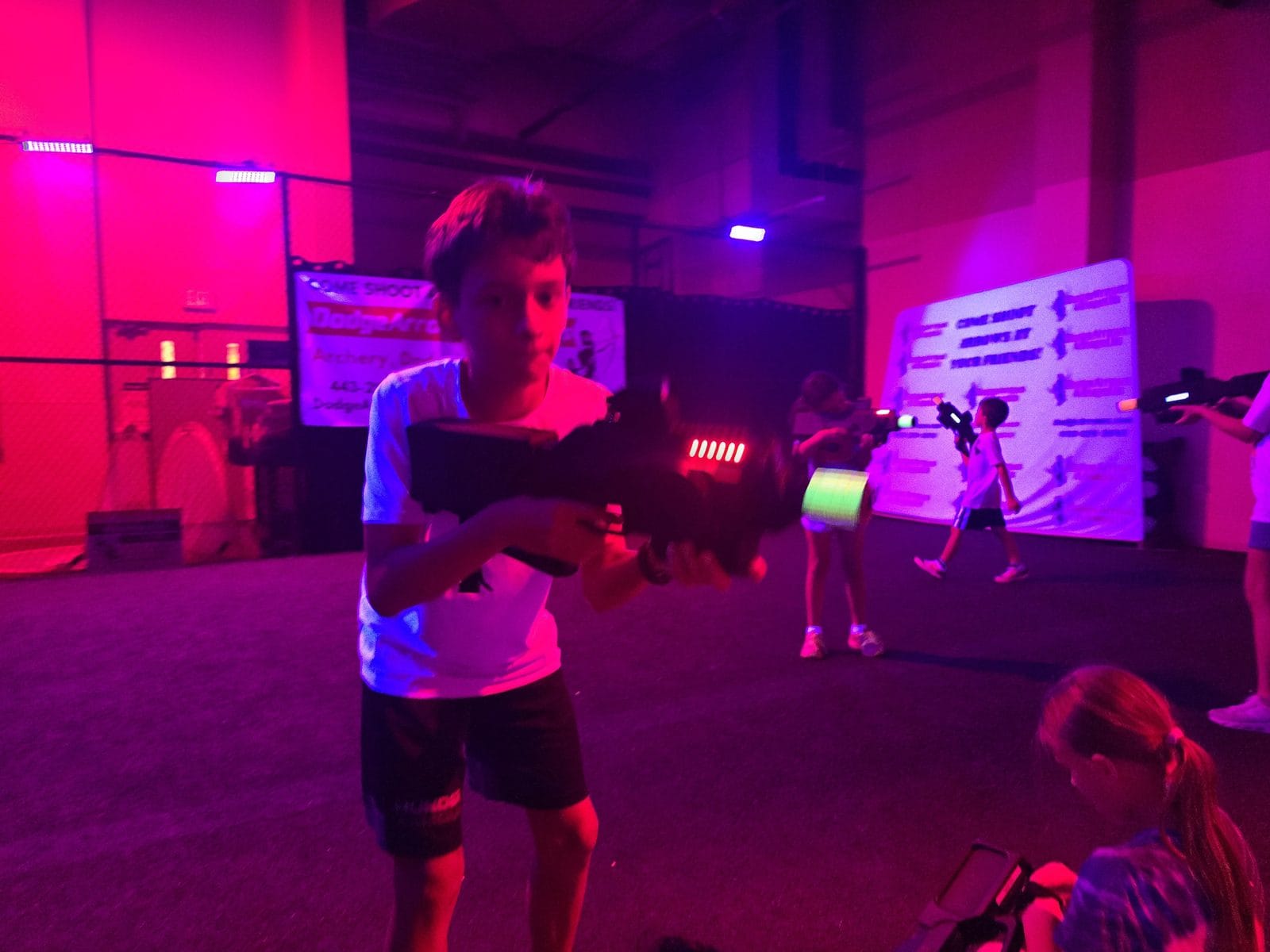
Laser tag is the best fit there is. It was built for low light, the guns light up on their own, and darkness makes hiding actually work. If you run one game all night, run this one.
Dodgeball works, with the luminous balls only. Standard dodgeballs vanish in the dark and somebody takes one to the face.
Reaction games work, because the equipment glows. Drop sticks are neon and need no light to read. Bop It is audio driven and works with your eyes shut, which makes it a good pick for the youngest guests.
Water balloons work outdoors, and the reusable kind saves you picking shards of latex out of a lawn in the dark.
Now the honest part. Axe throwing does not work in the dark — it needs a clearly visible target and a controlled lane. Great game, run it with the lights on. Cornhole fails because the bags disappear mid-flight. Board games fail because nobody can read a card.
The general principle: the faster something moves, the more it needs to glow. A slow game needs light to read it, and reading anything is what the dark takes away from you.
Three ways to build it
Pick the one that matches your space, not your ambition. A tiny setup in a garage beats a big setup spread too thin across a hall.
Starter, one room or a garage. The UV lantern, a roll of neon gaffer tape, and the luminous dodgeballs. Tape the floor, charge the balls under the lamp, kill the lights. That is a real glow party and it fits in a tote bag.
Mid, a basement or two-car garage. Add the 100 ft UV strip around the walls, the bubble machine with a gallon of solution, and a speaker.
Full build, a hall, gym or large yard. Add the 600W floods for coverage, the moving head lights and laser projector for the ceiling, the PartyBox and wireless mics for sound, and laser tag as the main event.
If you are deciding between one more light and better sound, buy the sound. A dim room with good music reads as intentional. A bright room with a phone speaker reads as unfinished.
Six things we got wrong
- One stray white light ruins the whole room. An exit sign, a microwave clock, a cracked door to a lit hallway. The eye adjusts to the brightest thing present and everything else stops glowing. Walk the room with the lights off before anyone arrives.
- Aim the lights across the room, not down. Pointed at the floor, a UV lamp lights a circle of floor. Pointed across at head height, it lights every person in the room. Same lamp, completely different party.
- Count your outlets before you buy. A full build can want six or eight plugs, and party rooms rarely have them where you need them.
- Tape down every cord you do run. In a dark room full of running kids, a cord across the floor is the most likely thing to end your night early.
- Charge the glow gear before guests arrive. Phosphorescent balls need ten minutes under the UV. We have started a party with dim equipment more than once.
- Keep one normal light switch within reach. You will need the room lit instantly at some point, for a spill or a scrape. Know where that switch is and tell one adult.
On safety generally: low light plus running is a sprained ankle waiting to happen. Mark boundaries and any step or edge with glow tape, keep the floor clear, keep bubbles off hard surfaces, and keep walking paths lighter than the play area.
Glow party questions we get asked
What do you need for a glow party at home?
Three things cover a basic glow party: a 395nm UV blacklight, neon gaffer tape to mark the floor, and something that glows for people to play with. A rechargeable UV lantern lights a room of roughly 15 by 15 feet. Add a speaker and a bubble machine and you have a full party.
What makes things glow under a blacklight?
A blacklight emits ultraviolet light that your eyes cannot see. Certain materials absorb that invisible light and re-emit it as a color you can see, which is why the object appears to glow from the inside while the lamp itself stays dark.
How many blacklights do I need for a room?
Plan on roughly one UV source per 200 square feet. A two-car garage needs about two. A church hall or gym needs six or more, at which point flood lamps become cheaper than buying individual lanterns. Aim them across the room at head height rather than down at the floor.
Does white clothing glow under a blacklight?
Yes. Plain white cotton glows brightly under UV because laundry detergents leave optical brighteners in the fabric. Guests do not need to buy special clothing, they just need to wear white or neon.
What colors glow the most under UV light?
Neon and fluorescent yellow, orange, pink and green glow hardest. White fabric, white paper, highlighter ink and tonic water also glow. Black, navy, dark red and most browns do not glow at all, no matter how much you spend on lighting.
Is 395nm or 365nm better for a glow party?
For a party, 395nm is the better choice. It makes things glow brightest and costs less. A 365nm lamp produces a purer glow with less visible purple haze, but it runs dimmer and costs more, which matters more for inspection work than for a birthday party.
What games work best in the dark?
Laser tag is the best fit, because it was designed for low light and the equipment lights itself. Dodgeball works if you use luminous balls. Reaction games like drop sticks and Bop It work because they are neon or audio driven. Axe throwing, cornhole and board games all fail in the dark because players cannot track the target.
How do you keep a glow party safe?
Mark boundaries and any step or edge with glow tape, tape down every cord, keep bubble machines off hard floors because the solution is slippery, keep walking paths brighter than the play area, and make sure one adult knows where the normal light switch is.
Not planning a glow night specifically? We also wrote up the party and camp gear we use day to day, including what we stopped buying.
Or let us run it
Everything here is doable at home, and plenty of families do it. What you are really buying with a DIY glow party is the setup and the teardown: taping a floor, hanging strips, charging gear, and packing it all away at 10pm while the sugar wears off.
If you would rather skip that part, we run glow nights at DodgeArrows Annapolis with the room already built, the lights already aimed, and somebody else cleaning up. Birthday parties, team events and camps.
Book a party at DodgeArrows Annapolis
See the full glow gear list
Ready for an Epic Experience?
Book your session at DodgeArrows and create unforgettable memories with friends, family, or your team!
Book Now